


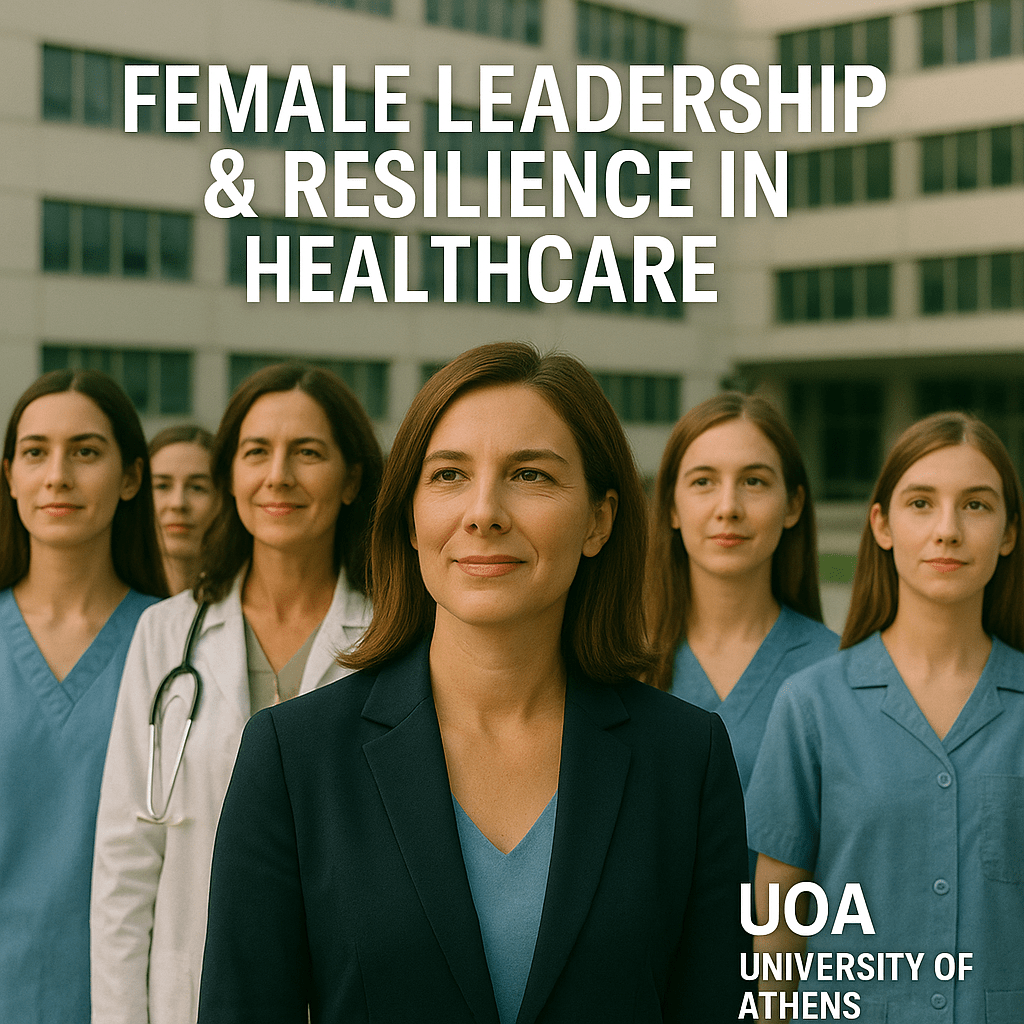

By Maria Antoniadou, Associate Professor
National and Kapodistrian University of Athens
Introduction: Women in Health
Women constitute an indispensable force in health and social care systems. According to the World Health Organization (WHO), approximately 67% of the global health and social workforce are women, which translates into hundreds of millions of frontline professionals providing services to nearly 5 billion people worldwide (World Health Organization, 2019). Their contribution spans the full spectrum of health services, from clinical medicine and nursing to midwifery, home care, social work, and mental health.
The economic value of this work is enormous: women’s contribution to health systems is estimated to exceed US$3 trillion annually (WHO, 2019). Nevertheless, the vast majority of this labor remains undervalued and often invisible. In many cases, it consists of low-paid positions, informal work, or even unpaid care, particularly in developing countries but not exclusively. The paradox is clear: while women sustain the everyday functioning of health systems, their voices and value remain marginalized.
This gender gap is not an isolated phenomenon but a systemic issue. Women tend to cluster in occupations characterized by lower status and lower wages, not due to a lack of skills or qualifications, but as a result of social norms, stereotypes, and institutional inequalities.
This systematic undervaluation of women in health has multiple consequences:
- It perpetuates the gender pay gap in the health and care sector, which stands at around 20% globally (WHO & ILO, 2022).
- It restricts women’s access to leadership positions and decision-making bodies (WHO, 2021).
- It undermines the sustainability and resilience of health systems themselves.
Recognizing and fairly valuing women’s contributions to health is not only a matter of social justice. It is a prerequisite for achieving Universal Health Coverage (UHC) and for closing the projected global shortfall of 15 million health workers by 2030 (WHO, 2019).
The Paradox: “Delivered by women, led by men”
The phrase “Delivered by women, led by men” encapsulates the structural paradox of health systems: women form the majority of the workforce but are systematically underrepresented in positions of power and decision-making. According to WHO analysis, women are concentrated in lower-status and lower-paid roles, such as nursing, midwifery, social work, and home care (World Health Organization, 2019). In contrast, men are overrepresented in higher-paying medical specialties and in administrative and leadership positions.
This occupational segregation does not reflect actual capabilities or education levels of women. Instead, it is fueled by deeply ingrained social stereotypes that perceive “women’s work” as a natural extension of women’s caregiving and nurturing roles. In practice, this leads to the systemic undervaluation of care professions, professions that are crucial for the physical, mental, and social health of populations.
Research by McKinsey (2022) shows that women’s underrepresentation is not limited to the frontline; it extends across all levels of the hierarchy. While women make up about two-thirds of the global health workforce, they hold less than 25% of senior leadership positions worldwide. As a result, decision-making processes are largely shaped without the equitable participation of those who constitute the backbone of the system.
The consequences of this segregation are manifold:
- The gender pay gap is reinforced, since men dominate higher-paid professions.
- Career advancement opportunities for women are limited, with many facing horizontal or vertical “glass ceilings.”
- Health systems lose the potential for more inclusive leadership, which could improve health policies and the quality of care.
The WHO emphasizes that changing this situation requires systematic policy intervention: revising pay structures, recognizing the skills required in “traditionally female” roles, and implementing affirmative measures to promote women into leadership positions (WHO, 2019). McKinsey adds that progress in this area remains slow and uneven, and without targeted strategies, the “glass wall” of professional inequality will continue to obstruct gender equality in health (McKinsey, 2022).
The Gender Pay Gap
Despite their overwhelming presence in health and care, women continue to earn significantly less than their male counterparts. The global analysis by the WHO and the International Labour Organization (The gender pay gap in the health and care sector: a global analysis in the time of COVID-19) shows that women earn on average 20% less than men in the same sector (WHO & ILO, 2022). This gap is even wider than that observed in many other economic sectors.
What explains -and what does not explain- the gap
Analysis of data from 54 countries highlighted two dimensions:
- The explained part: Certain factors, such as age, years of experience, education level, or position in the professional hierarchy, can account for a small portion of the gap. For example, in some countries men tend to have more years of experience or higher qualifications, particularly in upper pay bands.
- The unexplained part: The majority of the wage gap, about 22 percentage points, remains unexplained by objective characteristics. This means that women with the same qualifications, experience, and roles are still paid less than their male peers. Here, phenomena such as the undervaluation of female-dominated professions and the so-called “motherhood penalty” play a decisive role (WHO & ILO, 2022).
The “Motherhood Penalty” and the Undervaluation of Care
The so-called motherhood penalty is one of the most important drivers of the gender pay gap in health and care. As reported in the WHO/ILO analysis, women who become mothers face lower promotion prospects, are often pushed into part-time work, or interrupt their careers - leading to lower lifetime earnings compared with men or with women without children (WHO & ILO, 2022).
The report distinguishes between the “explained” and “unexplained” components of the pay gap. While the explained part relates to characteristics such as age, education, or contract type, the unexplained component -about +22%- is attributed to discrimination and social bias (WHO & ILO, 2022, pp. 67–74). Among these biases is the motherhood penalty: mothers are paid significantly less, even when they have the same professional qualifications as men or childless women.
At the same time, social norms continue to perceive the care of children, the elderly, and the sick as “women’s responsibility.” The consequence is that care-related professions—nursing, midwifery, social work, home care—suffer systematic wage devaluation. Even in advanced economies, workers in these fields are paid on average less than in professions requiring similar education but with greater male representation. This phenomenon is described in the report as the undervaluation of “over-feminized” professions (WHO & ILO, 2022, p. 74).
Implications
This undervaluation has major implications:
- It reduces the attractiveness of care professions for younger generations.
- It increases rates of burnout in already overstretched staff.
- It exacerbates staffing shortages in critical areas such as nursing, where demand is rapidly growing due to population aging.
In other words, the motherhood penalty and the devaluation of care professions are not only matters of justice for women. They also represent structural barriers to the resilience and sustainability of health systems themselves.
The Impact of the COVID-19 Pandemic
The COVID-19 pandemic acted as a magnifying glass on the pre-existing inequalities in the health and care sector. Women, who constitute about 67% of the global health and care workforce, were overwhelmingly on the front lines of the pandemic—as nurses, midwives, social workers, and caregivers (WHO & ILO, 2022, p. viii). Despite their critical role, most worked under extremely demanding and hazardous conditions without corresponding pay recognition.
The “artificial” narrowing of the gap
During 2019–2020, data showed that the gender pay gap in the health sector appeared reduced in some countries. However, this reduction was artificial. The reason is that a significant proportion of low-paid female workers—often in insecure or informal jobs—lost their employment disproportionately during lockdown measures. As a result, the average wage reported for women “increased,” not because pay improved, but because the lowest-paid women were excluded (WHO & ILO, 2022, pp. 93–120).
Decline in overall wage share
The report highlights that while average wages appeared to rise, in reality the total wage bill for women in the sector decreased. In other words, fewer women remained in paid employment, and those who did continued to be paid less than men with comparable qualifications (WHO & ILO, 2022, pp. 110–120).
The double burden
In addition, many women in health faced the “double burden”: beyond the demands of frontline pandemic work, they also took on a disproportionate load of unpaid household care (children, elderly, patients) due to school closures and reduced social services. This further exacerbated the motherhood penalty and restricted their career opportunities (WHO & ILO, 2022, pp. 67–74).
Exit strategies
The WHO and ILO warn that this crisis must not be seen as temporary. Instead, it requires systematic policy interventions to eliminate the gender pay gap and strengthen the resilience of women in health. Key strategies include:
- investment in decent jobs with stable contracts,
- tackling gender occupational segregation,
- ensuring equal pay for work of equal value, and
- institutionalizing mechanisms for pay transparency (WHO & ILO, 2022, pp. 125–131).
Why it matters
The gender pay gap in the health sector is not only a matter of fairness and gender equality; it is also a matter of system sustainability. The undervaluation of women’s work creates a chain reaction with three key consequences:
- Reduced attractiveness of the profession. When care professions are associated with low pay and limited advancement, they become less attractive to younger generations. This leads to recruitment difficulties, especially in areas already facing shortages such as nursing and primary care (WHO, 2019).
- Staffing and retention challenges. In 2022, the WHO and ILO emphasized that pay inequality drives women out of the sector, particularly when combined with unstable working conditions, precarious contracts, and insufficient work–life balance support (WHO & ILO, 2022, pp. 125–131). This exacerbates the global shortfall of 15 million health workers projected by 2030.
- Higher rates of burnout. Women on the front lines, usually in more demanding but lower-paid roles, experience higher rates of burnout. Burnout is not only an individual issue; it directly affects the quality of care, patient safety, and the long-term sustainability of services (WHO, 2019; WHO & ILO, 2022).
Therefore, the gender pay gap cannot be treated as a secondary issue. It is a critical determinant of health system resilience, of their capacity to respond to crises such as COVID-19, and of the achievement of the Sustainable Development Goals (SDG 3: Good Health and Well-Being; SDG 5: Gender Equality; SDG 8: Decent Work and Economic Growth).
Other things to consider
Double Burden and Work-Life Balance
The double burden is one of the most decisive factors of inequality for women in health and beyond. The WomenBridges methodology highlights that women are often required to balance between paid employment and unpaid care at home—whether this involves children, the elderly, or other relatives. The result is continuous stress, which reduces career advancement opportunities and undermines their overall quality of life (WomenBridges, 2021, pp. 9–11).
The “Invisible Work”
In most societies, household work and caregiving are perceived as a “woman’s responsibility.” This means that women often dedicate twice as much time to unpaid activities compared to men. WomenBridges documents that this social norm reinforces women’s economic vulnerability, as it limits their ability to engage in paid work, invest in education and skills, or pursue leadership positions (WomenBridges, 2021, p. 9).
Impact on Career Trajectories
The double burden has a direct effect on women’s professional trajectories. Many are forced to opt for part-time employment or temporary career interruptions. This, in turn, leads to lower earnings, reduced work experience, and fewer chances of promotion. This phenomenon is one of the key mechanisms fueling the motherhood penalty.
Impact on Health and Well-Being
Beyond career development, the double burden has significant consequences for personal well-being:
- less time for self-care,
- sleep deprivation,
- higher levels of stress and professional burnout.
WomenBridges stresses that finding a balance between paid and unpaid work is a constant challenge for women who aspire to build a career while simultaneously supporting their families (WomenBridges, 2021, pp. 10–11).
Proposed solutions
The methodology suggests a comprehensive framework of support, including:
- a combination of education, counseling, and mentoring,
- networking with other women and mentors (buddies),
- developing a human-centered work environment that recognizes women’s multiple identities (mother, professional, caregiver) and offers flexibility to balance family and professional life (WomenBridges, 2021, pp. 12–14).
The Leadership Gap
The WHO report Closing the Leadership Gap (WHO, 2021) highlights a major paradox: while women constitute the majority of the global health workforce (around 67%), they remain a minority in decision-making bodies. This asymmetry is not merely symbolic; it leads to poorer health outcomes for all, as policies and strategies are shaped without the meaningful participation of those who experience the everyday realities of care (WHO, 2021).
The COVID-19 pandemic further exposed this imbalance: although women were on the front lines, they rarely participated equally in the bodies that defined crisis management policies.
More recent studies confirm that the absence of women in leadership not only undermines equality but also deprives systems of proven benefits. The systematic review by Kalbarczyk et al. (2025), which analyzed 137 articles from 148 countries, concluded that women’s leadership is associated with positive outcomes across six domains:
- economic performance, risk management, and stability,
- strengthened innovation,
- engagement in ethical initiatives and transparency,
- improved health outcomes,
- better organizational climate and collaborative culture,
- inspiration for the careers and ambitions of other women (Kalbarczyk et al., 2025).
The same review stresses that these benefits are not independent of context: in systems that provide education, networks, and institutional support mechanisms, the positive effects multiply; in contrast, in environments without support, women leaders are limited in their ability to bring about change.
Furthermore, articles such as What Is Female Leadership And Why Do We Need It? (Globokar, 2023) and The Transformative Power of Women in Leadership Roles (Duchene, 2025) emphasize the qualitative features of female leadership: empathy, collaboration, ethical integrity, transparency, and a stronger focus on inclusivity. These traits are not simply “good intentions”; they foster trust, improve psychosocial support within teams, and lead to more sustainable organizational practices.
Thus, female leadership is not only about the right of women to claim equal positions; it is about the overall quality and effectiveness of leadership. When women occupy positions of responsibility, data show improved governance, greater resilience, and enhanced innovation. Moreover, they act as role models, inspiring other women to pursue similar career paths and breaking the vicious cycle of underrepresentation.
Policy Solutions for Gender Equality in Health
Addressing the gender gap in health cannot rely solely on goodwill. It requires a systematic policy framework that integrates gender equality at every level. The WHO report Closing the Leadership Gap (WHO, 2021) proposes four key areas of action:
- Building the foundations for equality. This includes legislation prohibiting discrimination and sexual harassment, the institutionalization of equality in recruitment and pay, as well as monitoring and accountability mechanisms.
- Challenging social stereotypes and norms. Awareness campaigns and educational programs are needed to counter beliefs that caregiving is “women’s work” or that leadership positions are more “suited” to men.
- Reforming organizational structures and culture. Workplaces must adopt family-friendly practices, such as flexible schedules, telework, equal parental leave, and fair promotion procedures that ensure inclusivity.
- Empowering and supporting women. Creating mentoring networks, access to leadership training programs, and funding for women-led initiatives in health are critical tools to promote women into positions of responsibility.
The Perspective of “Gender-Transformative” Policy
As emphasized by WHO (2021) and Kalbarczyk et al. (2025), policies should not only aim at reducing disparities; they must be gender-transformative - that is, they should transform the very structures that produce inequalities. This means that women are not merely integrated into existing mechanisms; rather, the mechanisms themselves must change to embed equality, participation, and fair valuation.
International experience
The literature shows that countries and organizations that have adopted such policies have witnessed:
- improved pay transparency,
- reduction of the gender pay gap,
- increased representation of women on boards and committees,
- better health and well-being outcomes in the population (WHO, 2021; Kalbarczyk et al., 2025).
Why gender equality matters
Achieving Universal Health Coverage (UHC) by 2030 requires integrating approximately 15 million new health professionals into the global workforce. This goal cannot be achieved without equitable policies ensuring decent working conditions, elimination of discrimination, pay equity, and meaningful access of women to leadership roles (McKinsey, 2022).
Equality is not a luxury; it is a functional necessity for health systems to respond to current and future challenges.
Conclusion
Gender equality in health is not simply a matter of justice; it is the driving force for:
- resilient and sustainable health systems,
- better quality of care for societies,
- advancing social and economic development.
Recognizing and fairly valuing women’s contribution to health is both a present duty and a future investment.
The call to action is clear:
- To governments: enact legislation for equal pay, decent working conditions, and meaningful representation of women in decision-making.
- To health organizations: invest in mentoring, leadership training, and family-friendly policies.
- To universities and professional networks: promote female leadership role models and amplify the voices of young professionals.
- To all of us: actively support change by challenging stereotypes and empowering the women around us.
Achieving equality is not only possible, it is essential. And the future of health depends on it.
1. Duchene, K. The Transformative Power of Women in Leadership Roles. Forbes. 22 January 2025. Available online: https://www.forbes.com/sites/kateduchene/2025/01/22/the-transformative-power-of-women-in-leadership-roles/ (accessed on 23 September 2025).
2. Globokar, L. What Is Female Leadership and Why Do We Need It? Forbes. 8 March 2023. Available online: https://www.forbes.com/sites/lidijaglobokar/2023/03/08/what-is-female-leadership-and-why-do-we-need-it/ (accessed on 23 September 2025).
3.Kalbarczyk, A.; Banchoff, K.; Perry, K.E.; Nielsen, C.P.; Malhotra, A.; Morgan, R. A Scoping Review on the Impact of Women’s Global Leadership: Evidence to Inform Health Leadership. BMJ Global Health 2025, 10, e015982. https://doi.org/10.1136/bmjgh-2024-015982.
4.McKinsey & Company. A Five-Year Review of Women’s Representation in Healthcare. 2022. Available online: https://www.mckinsey.com/industries/healthcare/our-insights/a-five-year-review-of-womens-representation-in-healthcare (accessed on 23 September 2025).
5. WomenBridges Team. WomenBridges Methodology Guide: Supporting Career Paths and Work-Life Balance of Women; Impact Drive Foundation: Sofia, Bulgaria, 2021. Available online: https://en.impactdrive.eu/ (accessed on 23 September 2025).
6. World Health Organization (WHO). Closing the Leadership Gap: Gender Equity and Leadership in the Global Health and Care Workforce. Policy Action Paper; WHO: Geneva, Switzerland, 2021. ISBN 978-92-4-002590-5. Available online: https://apps.who.int/iris/handle/10665/342824 (accessed on 23 September 2025).
7. World Health Organization (WHO). Delivered by Women, Led by Men: A Gender and Equity Analysis of the Global Health and Social Workforce. Human Resources for Health Observer Series No. 24; WHO: Geneva, Switzerland, 2019. ISBN 978-92-4-151546-7. Available online: https://apps.who.int/iris/handle/10665/311322 (accessed on 23 September 2025).
8. World Health Organization (WHO); International Labour Organization (ILO). The Gender Pay Gap in the Health and Care Sector: A Global Analysis in the Time of COVID-19; WHO & ILO: Geneva, Switzerland, 2022. ISBN 978-92-4-005289-5. Available online: https://apps.who.int/iris/handle/10665/361819 (accessed on 23 September 2025).

Call to Action
Do not miss the opportunity to become part of a community that supports your personal and professional growth and is dedicated to high-quality continuing education in dental and healthcare leadership.
The Center for Lifelong Learning (KEDIVIM) of the National and Kapodistrian University of Athens (UOA), with the support of the Leader Edu Team, invites you to join the pioneering program Resilience Mastery for Women in Healthcare.
The official launch will take place on October 1st, 2025, and from 2026 onwards the program will open new cycles every March 15th.
By participating, you will gain access to valuable knowledge, mentoring, and professional networks, while joining a growing movement of women empowering women in healthcare.
Our vision is to create a Membership Mentoring Club for female healthcare professionals, offering continuous guidance, empowerment, and opportunities for advancement. Prepare to be part of an initiative that is reshaping education and leadership in healthcare.
